Guide · · 8 min read
A walk through central Reykjavík: from Harpa to the pond
In short
This self-guided walk through central Reykjavík starts and ends at Harpa. It passes Sun Voyager, Hallgrímskirkja, the Einar Jónsson sculpture garden, the pond and City Hall, the Settlement Exhibition and Austurvöllur square. The seven legs add up to 51 minutes on foot, about 3.9 kilometres, by this site's walking matrix; with the stops it fills half a day.
- Only here
- The route timed leg by leg from this site's own walking matrix, place to place on OpenStreetMap at 5 km/h, with the total walking time and distance.
- Facts read
- 12 November 2026
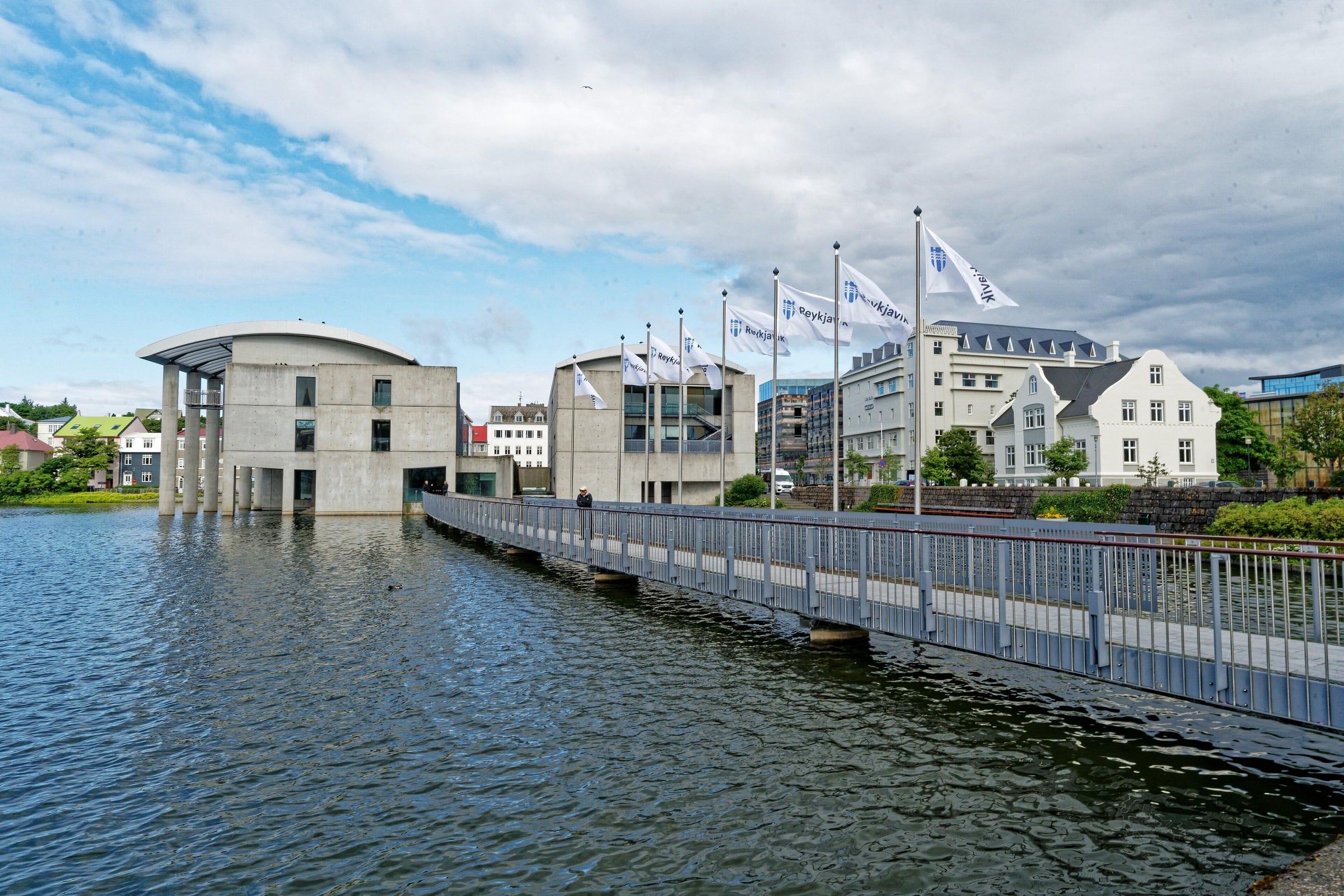
Reykjavík City Hall, two pale grey buildings with curved roofs, standing at the edge of Tjörnin, with a footbridge over the water and a row of white city flags.Photograph: Holger Uwe Schmitt, CC BY-SA 4.0

Central Reykjavík is small enough to see on foot in half a day. This walk starts at Harpa on the harbourfront, follows the shore to Sun Voyager, climbs to Hallgrímskirkja, comes down to the pond and returns through the oldest part of town. It has seven legs and takes 51 minutes of walking, about 3.9 kilometres; the longest leg is 14 minutes.
The table gives each leg as this site's walking matrix has it. The time at the stops is yours to add: the Settlement Exhibition alone takes one to two hours, by the museum's own estimate. In winter, set off in the morning, because the church tower and the exhibition both shut by 17:00.
| Leg | From | To | Walk | Distance |
|---|---|---|---|---|
| 1 | Harpa | Sun Voyager | 8 min | 660 m |
| 2 | Sun Voyager | Hallgrímskirkja | 10 min | 760 m |
| 3 | Hallgrímskirkja | Einar Jónsson sculpture garden | 4 min | 260 m |
| 4 | Einar Jónsson sculpture garden | Tjörnin and City Hall | 14 min | 1,150 m |
| 5 | Tjörnin and City Hall | The Settlement Exhibition | 4 min | 260 m |
| 6 | The Settlement Exhibition | Austurvöllur and the Parliament House | 3 min | 230 m |
| 7 | Austurvöllur and the Parliament House | Harpa | 8 min | 580 m |
| Total | Harpa | Harpa | 51 min | 3.9 km |
The other order at the end, Austurvöllur before the Settlement Exhibition, comes to 54 minutes: 5, 3 and 10 minutes for the last three legs in place of 4, 3 and 8.
Walking time only. The stops are extra: the Settlement Exhibition alone takes one to two hours by the museum's own estimate.
The matrix measures the route. It does not know the climb to the church, the wind off the bay or ice on the pavement.
Gathered by hand. Each leg is the walking route on OpenStreetMap between the two places, taken from this site's walking matrix (computed on 12 November 2026), turned into time at 5 km/h and rounded up to the whole minute. Distances are the same routes, rounded to the nearest 10 metres. The total is the seven legs added together. Facts read 12 November 2026. The table as data
Where each row was read (2 pages)
- 1openstreetmap.orgOpenStreetMap, the street and path data on which this site's place-to-place walking matrix is worked out (content/walk-between.json, computed on 12 November 2026).
- 2borgarsogusafn.isReykjavík City Museum's access page, as held in this site's record of the Settlement Exhibition: visit duration one to two hours.
Harpa, where the walk begins
Harpa stands where the centre meets the harbour: a concert hall and conference centre cased in glass. A hall for music was first called for in the Icelandic press in 1881, by Harpa's own account, and it took 130 years to arrive. Building began on 12 January 2007, stopped in October 2008 and started again in March 2009. The Iceland Symphony Orchestra played the first concert in the main hall, Eldborg, on 4 May 2011.
The glass is the thing to look at. The artist Olafur Eliasson designed the façade with the architects, Henning Larsen Architects of Denmark and Batteríið Architects of Iceland, and has said he wanted a surface that would mirror the Icelandic surroundings and belong to them. On the square outside, find the two artworks. The Musician, by Ólöf Pálsdóttir, dates from 1970; a cellist sat for it and played while she worked. Himinglæva, by Elín Hansdóttir, sounds notes when the wind blows.
Going in costs nothing, and the doors open at 10:00 every day. Inside, on floor K2, is Volcano Express, a volcano show about how volcanoes shape the country and its people. A show starts every 15 minutes until the evening, so it fits before you set off just as well as when you come back with tired legs. There is more about it at the end of the walk.
Sun Voyager
Leave Harpa with the sea on your left and follow the shore east. After eight minutes you reach Sólfar, the Sun Voyager, a steel frame in the shape of a boat, 16 metres wide and 9 high.
Its story begins with a birthday. For Reykjavík's 200th anniversary in 1986, the residents' association of Vesturbær, the west of town, held a competition for an outdoor artwork, and Jón Gunnar Árnason's design won. The original was a small aluminium sculpture, given to the city so that it could be made large. The full-size work was unveiled here on 18 August 1990, the city's birthday. The artist had died the year before and never saw it finished.
It was made to look like a Viking ship, but the Reykjavík Art Museum, which keeps it, describes something else: a dream vessel and an ode to the sun, holding a promise of undiscovered land. Look past it over Faxaflói bay to Mount Esja before you turn inland.
Hallgrímskirkja and its tower
Turn your back on the sea and climb for ten minutes to Skólavörðuholt, the hill the church stands on. Hallgrímskirkja is the largest church in Iceland and a memorial to the hymn poet Hallgrímur Pétursson.
A design competition in 1929 asked for room for 1,200 people and a tall tower that could serve the radio broadcasts then being planned. The State Architect, Guðjón Samúelsson, began the drawings in 1937. It was his last work, and the church says its form recalls columns of rock, mountains and glaciers. Building started in 1945, and the church was consecrated on 26 October 1986, forty-one years later.
Inside, look for the concert organ in the west gable. The Klais workshop in Bonn built it, and it was first played in December 1992: 72 stops, 5,275 pipes, 15 metres high. Donations paid for most of it, and people were invited to buy a pipe each. In the tower hang three large bells, named Hallgrímur, Guðríður and Steinunn after the poet, his wife and their daughter, and a carillon of 29 more.
The nave is free. The tower, 73 metres high, costs 1,500 kr for an adult, paid in the church shop on the day. In winter the last admission is at 16:45, and church and tower close during services.
The Einar Jónsson sculpture garden
Next to the church, four minutes from its door, is the Einar Jónsson Museum, and behind it a garden of bronzes. Einar Jónsson (1874–1954) was the pioneer of Icelandic sculpture, in the museum's words. He drew the building himself around 1916, with the master builder Einar Erlendsson, moved in with his wife Anna in 1920 and saw it open to the public in 1923.
The garden holds 26 bronze casts of his works. Folk tales, religious ideas and mysticism were his sources, the museum says, and you can take the figures at your own pace: the garden is open to everyone all year, day and night. You have met him once already on this walk. Two of his works stand inside Hallgrímskirkja, a small bronze in memory of Hallgrímur Pétursson and a statue of Christ that he gave the church in 1948.
The museum indoors, with the couple's flat kept as it was, is a separate visit with its own ticket, open from 10:00 to 17:00.
Tjörnin and City Hall
The longest leg, 14 minutes, takes you down the west side of the hill to Tjörnin, the Pond. The town grew up at its north end, and the pond has been in the middle of it ever since.
The pond is an old sea lagoon that closed off more than 1,200 years ago and slowly turned fresh, fed by groundwater. Its outlet, Lækurinn, the brook, still runs north to the sea, underground now. Birds have been protected here since 1919; before that, the City says, hunters used the place. Five kinds of duck nest regularly, the mallard the commonest, greylag geese come for the winter, and swans were first brought here in the summer of 1920. When the pond freezes, look for the patch near Iðnó that warm water keeps open. People have long skated on the ice, and the skating club dates from 1892.
City Hall stands at the water's edge on the northern bank. Two young architects, Margrét Harðardóttir and Steve Christer, won the competition for it in 1987 against 37 other proposals, and it was inaugurated on 14 April 1992. Go in. In Tjarnarsalur, the hall beside the pond, lies a relief model of the whole country, 7.22 by 10.58 metres. The city's model makers began it in 1985 and cut it from cardboard one millimetre thick, each sheet standing for 20 metres of height: 106 layers from the shore to the top of Öræfajökull.
The hall is open on weekdays from 8:00 to 18:00, on Saturdays from 10:00 and on Sundays from 12:00, unless it is reserved for an event.
The Settlement Exhibition
North of City Hall, four minutes away on Aðalstræti, is the place where the town began. The City puts the first farm of Reykjavík at this end of the pond, and the square that comes next on the walk was its best field.
The Settlement Exhibition shows what was found under the street: the remains of a longhouse from the tenth century, left in place below the pavement, with the exhibition built around them. The light is kept low and the floor is uneven in places. From the old hall an underground corridor leads to Aðalstræti 10, built in 1762 for the Innréttingar, the workshops that set out to bring modern industry to Iceland and marked the beginning of the town. A part added in May 2022 carries the story from the settlement to the present day.
The museum suggests one to two hours. It is open daily from 10:00 to 17:00; an adult pays 3,100 kr and under-18s go in free.
Austurvöllur and the Parliament House
East of Aðalstræti, three minutes on, is Austurvöllur, the east field. It once reached from Aðalstræti to Lækjargata and south to the pond. The ground was wet, so the first builders left it alone, and in the 1830s the governor forbade building on it to keep an open space in the town. From 1902 to 1937 it was fenced and shut to the public. Now it is where Reykjavík gathers for concerts, holidays and protests, and where the Oslo Tree is lit before Christmas.
In the middle stands Jón Sigurðsson, the leader of Iceland's independence movement. The statue was moved here in 1931, taking the place of one of Bertel Thorvaldsen, and carried no name until 2011, two hundred years after his birth.
At the south end is Alþingishúsið, the Parliament House. In 1867 the parliament resolved to mark a thousand years of settlement with a house of Icelandic stone. Ferdinand Meldahl, a Danish architect, drew it, and it was built in 1880–81 of basalt hewn on Skólavörðuholt, the hill where you stood at the church earlier on this walk. On the front, pick out the crown and crest of King Christian IX on the roof, the date 1881 in metal numerals under the eaves and, over the upper windows, the four guardian spirits of Iceland: a giant, a bird, a bull and a dragon.
The cathedral, Dómkirkjan, stands beside it. Whether visitors can go inside the parliament could not be read on its own site on 12 November 2026.
Back to Harpa, and Volcano Express
The last leg is eight minutes. It is three to Lækjartorg, the square where the town's buses meet, and five more to the glass front you started from.
This is a good moment for Volcano Express. You sit down, the show is the same in any weather, and one starts every 15 minutes between 10:00 and 20:00, so the walk does not have to be planned around it. After a pre-show you walk through, the film runs for 10 minutes on motion seats, with heat, cold and tremors, and it tells how volcanoes shape the country and its people. Children can come from the age of 4, if they are at least 100 cm tall, and there are still seats and a wheelchair area for anyone who wants them.
Tickets are sold at the desk in Harpa, though the operator recommends booking ahead because seats are limited. The visit takes 45 min at most, and an adult ticket is 3,990 kr.
How the route was timed
Each leg is the walking route on OpenStreetMap between the two places, as this site's walking matrix holds it, turned into minutes at five kilometres an hour and rounded up to the whole minute. The total is the seven legs added together. The matrix does not know the climb to the church, the wind off the bay or ice on the pavement, so read 51 minutes as the least the walking takes.
For more to see once the walk is done, see fourteen things to do on a first visit.
Questions
How long does it take to walk around central Reykjavík?
This loop from Harpa past Sun Voyager, Hallgrímskirkja, the pond, the Settlement Exhibition and Austurvöllur and back to Harpa is 51 minutes of walking, about 3.9 kilometres, by this site's walking matrix. With the church tower, City Hall and the exhibition, allow half a day.
Where is a good place to start a walk in Reykjavík?
Harpa. It stands on the harbourfront five minutes on foot from Lækjartorg, the square where the town's buses meet, and there is a car park under the building. Admission is free and the doors open at 10:00 every day.
How far is Hallgrímskirkja from Harpa?
Fourteen minutes on foot by the direct route, about 1.1 kilometres, by this site's walking matrix. By way of Sun Voyager, as on this walk, it is eight minutes along the shore and ten more up the hill.
Is Hallgrímskirkja free to enter?
The nave is: the city's tourist office states that admission to the church is free. The tower is a separate visit with a ticket, sold in the church shop on the day. Both close to visitors during services, including the Sunday service at 11:00.
Can you go inside Reykjavík City Hall?
Yes. The ground floor is open on weekdays from 8:00 to 18:00, on Saturdays from 10:00 and on Sundays from 12:00. The relief model of Iceland in Tjarnarsalur can be seen during those hours unless the hall is reserved for an event.
The experiences in this post
As they stand on this site today; each has its own page with every fact sourced.
- Volcano ExpressEvery 15 min, 10:00–20:003,990 kr
- Hallgrímskirkja towerWalk in, 10:00–16:451,500 kr
- The Settlement ExhibitionWalk in, 10:00–17:003,100 kr
Sources
- 1harpa.is/en/historyHarpa: the call for a concert hall in 1881, the building dates, the first concert on 4 May 2011.
- 2harpa.is/en/the-designHarpa: the principal designers, and Olafur Eliasson on the glass façade he designed with the architects.
- 3harpa.is/en/outdoor-artworkHarpa: the two artworks outside, The Musician and Himinglæva.
- 4harpa.is/en/opening-hoursHarpa: the building opens at 10:00 every day; Volcano Express on floor K2, 10:00 to 20:00, a show every 15 minutes.
- 5harpa.is/en/welcomeHarpa: admission to the building is free.
- 6volcanoexpress.is/admission-opening-hoursVolcano Express: price, opening hours, a show every 15 minutes, the age rule.
- 7volcanoexpress.is/faqVolcano Express: the pre-show, the 10-minute film on motion seats, the length of the visit, seating, booking advice.
- 8volcanoexpress.is/accessibilityVolcano Express: the wheelchair area and static seating.
- 9volcanoexpress.is/locationVolcano Express: Lækjartorg about five minutes' walk away, the car park under Harpa (as held in this site's record).
- 10listasafnreykjavikur.is/en/collection/item/solfar-jon-gunnar-arnason-90781Reykjavík Art Museum's record of Sólfar: the size, the 1986 competition, the aluminium original, the unveiling on 18 August 1990 and the museum's description of the work.
- 11visitreykjavik.is/service/sun-voyagerVisit Reykjavík on Sun Voyager: the likeness to a Viking ship and the view of Esja and Faxaflói bay.
- 12hallgrimskirkja.is/en-gb/husið-og-saganHallgrímskirkja: the memorial to Hallgrímur Pétursson, the 1929 competition, the architect, the building dates, the consecration on 26 October 1986, the 73-metre tower.
- 13hallgrimskirkja.is/en-gb/orgelinHallgrímskirkja: the Klais organ of December 1992, its stops, pipes and height, and how it was paid for.
- 14hallgrimskirkja.is/en-gb/kirkjuklukkurHallgrímskirkja: the three large bells and their names, and the carillon of 29 bells.
- 15hallgrimskirkja.is/en-gb/kirkjumunir-og-listaverkHallgrímskirkja: the two works by Einar Jónsson inside the church.
- 16hallgrimskirkja.is/en-gb/opnunartimarHallgrímskirkja: winter hours, last tower admission at 16:45, tickets in the church shop, closures during services.
- 17visitreykjavik.is/service/hallgrimskirkja-churchVisit Reykjavík: admission to the church is free of charge.
- 18listasafn.is/en/visit/einar-jonsson-museum/The Einar Jónsson Museum: the garden of 26 bronze casts, open to everyone day and night; the preserved flat; the opening in 1923; museum hours.
- 19listasafn.is/heimsaekja/listasafn-einars-jonssonar/The museum's Icelandic page: the house drawn around 1916 with Einar Erlendsson, and the couple's move there in 1920.
- 20reykjavik.is/en/hljomskalagardurinn-tjornin-and-vatnsmyriThe City of Reykjavík on Tjörnin: the old sea lagoon, its outlet Lækurinn, the birds and their protection since 1919, the swans of 1920, freezing and skating.
- 21reykjavik.is/en/reykjavik-city-hallCity Hall: opening hours, Tjarnarsalur, and how the relief model of Iceland was made.
- 22visitreykjavik.is/city-hallVisit Reykjavík on City Hall: the architects, the competition of 38 proposals decided in June 1987, the inauguration on 14 April 1992.
- 23borgarsogusafn.is/en/exhibitions/the-settlement-exhibitionReykjavík City Museum on the Settlement Exhibition: the open excavation, the addition of May 2022, Aðalstræti 10 built in 1762 for the Innréttingar.
- 24borgarsogusafn.is/en/adalstraeti-enReykjavík City Museum on Aðalstræti 10 and 16: the tenth-century longhouse and the underground link between the two houses.
- 25borgarsogusafn.is/en/accessReykjavík City Museum's access page, as held in this site's record: lighting, the uneven floor and the visit of one to two hours.
- 26borgarsogusafn.is/en/opening-hoursReykjavík City Museum: daily opening hours, as held in this site's record (the hours load only in a browser).
- 27reykjavik.is/en/austurvollurThe City of Reykjavík on Austurvöllur: the farm's field and its extent, the building ban of the 1830s, the fence of 1902 to 1937, the statue of Jón Sigurðsson, events and the Oslo Tree.
- 28visitreykjavik.is/service/althingi-parliament-houseVisit Reykjavík on the Parliament House: the resolution of 1867, the architect, the basalt from Skólavörðuholt, the details of the front.
- 29thjodminjasafn.is/en/um-safnid/saga-safnsinsThe National Museum's history page, which names Jón Sigurðsson as the leader of Iceland's independence movement.
- 30althingi.is/The parliament's own site, read for visits inside: it answered with a browser check on 12 November 2026 and could not be read.
- 31openstreetmap.org/copyrightThe street and path data the walking routes are worked out on.
All read on 12 November 2026.
To be read again: Re-read the opening hours of Hallgrímskirkja, City Hall, Harpa and the Settlement Exhibition before summer hours begin in May 2027, and try althingi.is again. The leg times change only if the walking matrix is rebuilt.