Guide · · 5 min read
Northern lights in Reykjavík: where to look and when to go
In short
From early September to early April Reykjavík has nights dark enough for the northern lights, and on a clear night with an active sky they can be seen from inside the city. Check the Icelandic Met Office's cloud and aurora forecast, get away from street lights to the shore, a park or a hill, and dress for standing still.
- Only here
- A month-by-month table of how many hours of full darkness Reykjavík has on the night of the 15th, September 2026 to April 2027, worked out by us with the NOAA solar equations and checked against the Met Office's own times.
- Facts read
- 12 November 2026
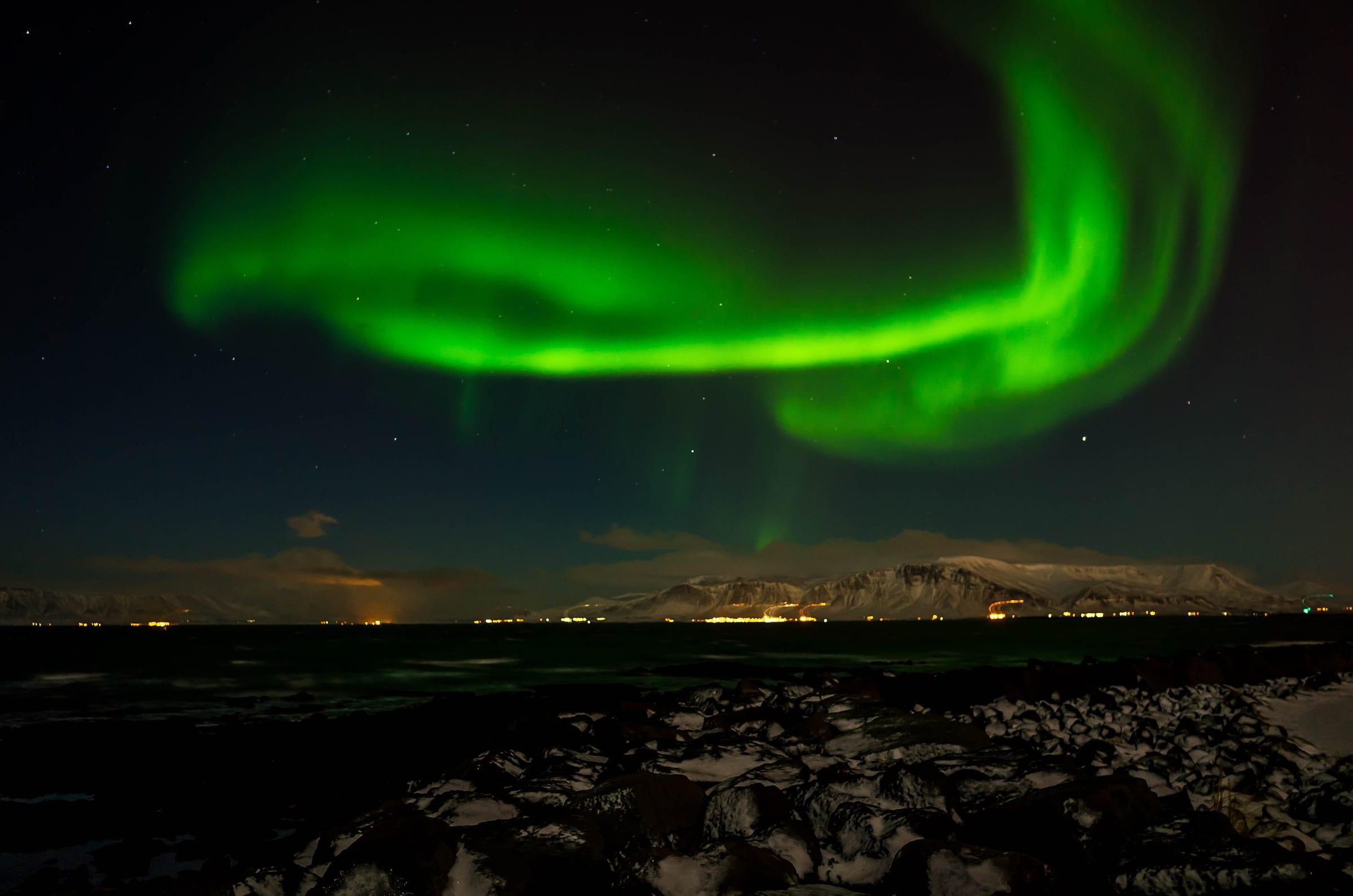
Northern lights over the bay and Mount Esja, seen from the Reykjavík shore on a January evening.Photograph: sergejf, CC BY-SA 2.0

The northern lights are not a show that starts on time. They need a dark night, a clear sky and an active aurora all at once, and none of the three can be booked. But Reykjavík is a good place to wait for them: on the right night they can be seen from inside the city, and if the sky stays shut there are warm places to go, from Volcano Express in Harpa to the hot tubs of the city pools.
This guide covers when the dark season runs, how to read the forecast, where to look in town, and what to do when it clouds over.
When it is dark enough
In summer the sky over Reykjavík never gets dark at all, so the season is set by the sun. By our own sums, the sun first sinks far enough below the horizon for full darkness on the night of 2 September 2026, for about an hour, and last does so around 9 April 2027. Between those dates the dark nights grow fast: from under five hours of full darkness in mid-September to almost thirteen around the winter solstice.
The city's visitor office names November to March as the peak months, when the nights are longest. The table shows how much darkness each month gives.
| Night beginning | Full darkness: sun more than 18° below the horizon | From – to | Dark enough for a strong display: sun more than 6° below | From – to |
|---|---|---|---|---|
| Tuesday 15 September 2026 | 4 h 50 min | 22:58 – 03:48 | 9 h 22 min | 20:42 – 06:05 |
| Thursday 15 October 2026 | 8 h 53 min | 20:48 – 05:40 | 12 h 36 min | 18:56 – 07:32 |
| Sunday 15 November 2026 | 11 h 37 min | 19:24 – 07:02 | 15 h 32 min | 17:27 – 08:59 |
| Tuesday 15 December 2026 | 12 h 54 min | 18:56 – 07:50 | 17 h 12 min | 16:48 – 09:59 |
| Friday 15 January 2027 | 12 h 15 min | 19:29 – 07:45 | 16 h 19 min | 17:27 – 09:46 |
| Monday 15 February 2027 | 9 h 55 min | 20:44 – 06:39 | 13 h 37 min | 18:52 – 08:30 |
| Monday 15 March 2027 | 6 h 41 min | 22:15 – 04:56 | 10 h 41 min | 20:15 – 06:56 |
| Thursday 15 April 2027 | none | – | 7 h 01 min | 21:57 – 04:58 |
By the same sums the sun first sinks 18 degrees below Reykjavík's horizon this season on the night of Wednesday 2 September 2026, for about an hour, and last does so around Friday 9 April 2027, for under half an hour. Before and after those nights there is no full darkness at all.
The longest night falls at the solstice, Monday 21 December 2026: 12 h 56 min of full darkness, and 17 h 15 min with the sun more than 6 degrees down.
Checks. At midsummer, 15 and 21 June 2027, the same sums give no darkness of either kind: the sun's lowest point is about 2.4 degrees below the horizon. A second, independent set of formulas (the low-precision ones of the Astronomical Almanac, which work from sidereal time) gives the same eight nights to the minute.
The Icelandic Met Office's aurora page prints sunset, a period it labels Dark, and sunrise for Reykjavík. For the ten nights from 12 to 21 November 2026, read on 12 November, its three times agree with ours to within a minute when Dark is taken as the sun 6 degrees below the horizon. That is why the second pair of columns uses 6 degrees.
Times are rounded to the nearest minute, so a duration can differ by a minute from the gap between the two clock times beside it.
Gathered by hand. Worked out by us on 12 November 2026 for 64.15°N, 21.94°W with the solar position equations of the NOAA Global Monitoring Laboratory, which follow Jean Meeus's Astronomical Algorithms: the sun's declination and the equation of time give the height of its centre above the horizon at any moment. Each cell is the time between the evening and the morning moment at which the sun crosses 18 degrees, or 6 degrees, below the horizon, on the night that begins on the evening of the 15th. Refraction, cloud and moonlight are left out. Clock times are Icelandic time, which is UTC all year. Facts read 12 November 2026. The table as data
Where each row was read (2 pages)
- 1gml.noaa.govNOAA Global Monitoring Laboratory: what its solar calculations are based on (equations from Astronomical Algorithms by Jean Meeus) and how accurate they are.
- 2en.vedur.isIcelandic Met Office aurora forecast: the sunset, Dark and sunrise times for Reykjavík for 12 to 21 November 2026, used to check our figures.
Full darkness here means the sun more than 18 degrees below the horizon. A strong display can show well before that, once the sun is about 6 degrees down, which is also the moment the Met Office marks as "Dark" on its forecast page. On 15 November that is from 17:27 in the evening; on 15 December, from 16:48.
Reading the forecast
The forecast to use is the Icelandic Met Office's aurora page. It has two parts, and the first matters more.
The big map shows the forecast cloud cover over Iceland for several days ahead: green areas are cloudy, white areas are clear. Move the slider under the map, or click a day and time, to see how the cloud will move. The small box in the corner gives the forecast auroral activity at midnight on a scale of 0 to 9. The page also lists the times of sunset, darkness, sunrise and moonrise for Reykjavík.
A high number under a green map means you will see nothing; a modest number under a white map is worth going out for. A bright moon lightens the sky and hides the faintest displays, so check the moonrise too.
Where to look in the city
Street lights are the enemy of a faint aurora, so the trick in town is to find somewhere with a wide view of the sky and as little light as possible around you. The city's visitor office suggests these, among others.
The Old Harbour and the seafront
The harbour and the seafront path along Sæbraut look north over the bay to Mount Esja, with no buildings in the way, and the north is often where the lights first appear. The walk along the shore from Harpa passes Sun Voyager, 12 minutes on foot from Lækjartorg.
Þúfa in Grandi
At the end of Grandi harbour, the grass mound Þúfa has a path to its top, and from there you see the whole sky with the city's lights behind you. It is a walk of about 35 minutes from Lækjartorg, past the museums of Grandi.
Tjörnin
The pond in the middle of town is a surprise on a strong night. The open water keeps the street lights at a distance, and on a still evening the lights can show in the water as well as the sky. It is a few minutes' walk from Lækjartorg.
Öskjuhlíð hill
The wooded hill where Perlan stands rises above most of the city's glow, and the trees screen the nearest lamps. Perlan's own observation deck, which comes with every ticket, looks out in every direction.
Elliðaárdalur and Grótta
Further out, the river valley of Elliðaárdalur sits away from the main roads, dark and quiet, with paths along the water. And at the western tip of the Seltjarnarnes peninsula, Grótta lighthouse looks over the open sea; the visitor office notes a small geothermal footbath nearby, Kvika, free to use, for warming your feet while you wait. Both are a bus ride or a drive from the centre.
Dress for standing still
Watching the aurora means standing in one place for a long time, often near the sea, and Reykjavík winter nights are cold: on the morning of 11 November 2026 the beach at Nauthólsvík read minus 2°C in the air. Wear more than you would for a walk, with a hat, gloves and something windproof on top, and bring a warm drink. Let your eyes adjust to the dark for a few minutes before you decide there is nothing there, and keep your phone screen dim.
If you would rather be taken somewhere dark, the visitor office lists bus, boat and jeep tours that leave the city to chase clear skies, and says most operators offer a free second try if the lights do not show.
If it clouds over
A cloudy night is not a lost night. Watch the cloud map, and go somewhere warm in the meantime.
Volcano Express is the easiest to fit in. It is inside Harpa on the harbourfront, 5 minutes from Lækjartorg, and open every day until 20:00 with a show every 15 minutes, so there is no time to plan around. It is not about the aurora: it is a volcano show about how volcanoes shape the country and its people, with a 10-minute film of real eruption footage seen from motion seats. The whole visit takes up to 45 min, and an adult pays 3,990 kr. Afterwards the Harpa seafront, one of the dark spots above, is right outside.
Aurora Reykjavík, in Grandi, is a centre given over to the northern lights: an exhibition on their science and folklore, a 30-minute aurora film and a virtual-reality aurora. It closes at 17:00, so it is a plan for the afternoon before a night of watching rather than for the night itself.
Perlan, on its hill, has a planetarium show about the northern lights among its exhibits, open until 21:00, and the observation deck outside for when the cloud breaks.
And there is the Reykjavík answer: an outdoor hot tub at a city pool, open late, where you can keep one eye on the sky. Laugardalslaug is open until 22:00 every day. See the city's pools and lagoons for how a visit goes.
How the table was worked out
The darkness figures are ours. For Reykjavík, at 64.15°N and 21.94°W, we used the solar position equations published by NOAA's Global Monitoring Laboratory to find, on the night of the 15th of each month, when the sun's centre crosses 18 degrees and 6 degrees below the horizon, evening and morning. A second, independent set of formulas gave the same times, and the Met Office's own sunset, Dark and sunrise times for 12 to 21 November 2026 agree with ours to within a minute. Times are Icelandic time, which is UTC all year.
Questions
Can you see the northern lights from Reykjavík?
Yes, when three things meet: a dark night, a clear sky and an active aurora. The city's visitor office says the lights can appear right above the city, though street lights hide faint displays, so the shore, the parks and the hills give the best chance.
When is the northern lights season in Reykjavík?
By our sums the sun first sinks far enough below the horizon for full darkness on 2 September 2026 and last does so around 9 April 2027. The city's visitor office names November to March as the peak months, when the nights are longest.
How do I check the aurora forecast in Iceland?
Use the Icelandic Met Office's aurora page. A map shows the forecast cloud cover, with green for cloud and white for clear sky, and a box shows the forecast auroral activity at midnight on a scale of 0 to 9. Clear skies matter more than a high number.
Where in Reykjavík can I see the northern lights?
Somewhere dark with a wide view of the sky: the Old Harbour and the seafront, which look north over the bay, Þúfa in Grandi, the pond Tjörnin, Öskjuhlíð hill, Elliðaárdalur valley, or Grótta lighthouse at the western tip of Seltjarnarnes.
What can I do in Reykjavík if it is cloudy at night?
Go indoors and wait for the forecast to change. Volcano Express, inside Harpa in the centre, is open until 20:00 with a show every 15 minutes. Perlan's exhibitions, including a planetarium northern lights show, are open until 21:00, and an outdoor hot tub at a city pool lets you keep one eye on the sky.
The experiences in this post
As they stand on this site today; each has its own page with every fact sourced.
- Volcano ExpressEvery 15 min, 10:00–20:003,990 kr
- Aurora ReykjavíkWalk in, 10:00–16:303,900 kr
- PerlanWalk in, 09:00–21:007,090 kr
- LaugardalslaugWalk in, 06:30–22:001,500 kr
- Sky LagoonBooked time14,990 kr
Sources
- 1en.vedur.is/weather/forecasts/aurora/The Icelandic Met Office's aurora forecast: the cloud-cover map, the 0 to 9 activity scale at midnight, sun and moon times for Reykjavík.
- 2visitreykjavik.is/northern-lights-in-reykjavikThe city's visitor office on viewing in Reykjavík: the conditions, the spots in town, the season and the peak months, tours.
- 3gml.noaa.gov/grad/solcalc/calcdetails.htmlThe NOAA solar position equations used for the darkness table.
- 4volcanoexpress.is/admission-opening-hoursVolcano Express: open every day 10:00 to 20:00, a show every 15 minutes.
- 5aurorareykjavik.is/Aurora Reykjavík: the northern lights centre in Grandi, its exhibition and opening hours (as recorded on this site on 11 November 2026).
- 6perlan.is/visitPerlan: exhibition hours and the planetarium northern lights show.
- 7nautholsvik.is/en/The beach's air reading on the morning of 11 November 2026.
All read on 12 November 2026.
To be read again: The darkness table is for the 2026–27 season; work it out again for September 2027. Re-read the Met Office forecast page and the city's list of viewing spots each autumn.